Part 1: Auto-reply ≠ response: the difference customers can feel
Written By: OutPerform
6 Minutes Read

Built on Gartner primary survey data (3,566 customers, Feb–Mar 2026).
"Thank you for contacting us! Our team will get back to you shortly."
It arrives in under a second. It contains no information. It commits to nothing. And the customer who receives it knows exactly what it is, because they have received the same sentence from every business they have ever messaged.
A business that sends this and counts it as a response has not responded. It has acknowledged receipt. Those are different things, and the gap between them is where a surprising amount of revenue goes missing.

Eric Keller, Senior Director Analyst in Gartner's Customer Service & Support practice, puts the design principle plainly:
"Service leaders should not use GenAI as a mandatory first step for every issue. When customers are forced through multiple unsuccessful AI interactions before they can reach a person, they are less likely to use that tool again."
Source: Gartner, 4 August 2026.
Read those numbers together and the picture is clear. Customers do not object to automation. They object to automation that stands between them and progress. Half of them find AI genuinely helpful. Nearly nine in ten want a visible exit. Automation that helps is welcome; automation that blocks is resented and the customer can tell the difference immediately.
The test that separates the two
Here is the only question worth asking about any automated first message:
After reading this, does the customer know something they didn't know before, or is something now happening that wasn't happening before?
If the answer to both is no, it is an acknowledgement. It buys you nothing except a record that a message was sent.
Consider two replies to the same WhatsApp enquiry about a property launch.
Acknowledgement:
"Thanks for your interest in Residensi XYZ! Our sales team will contact you soon."
Response:
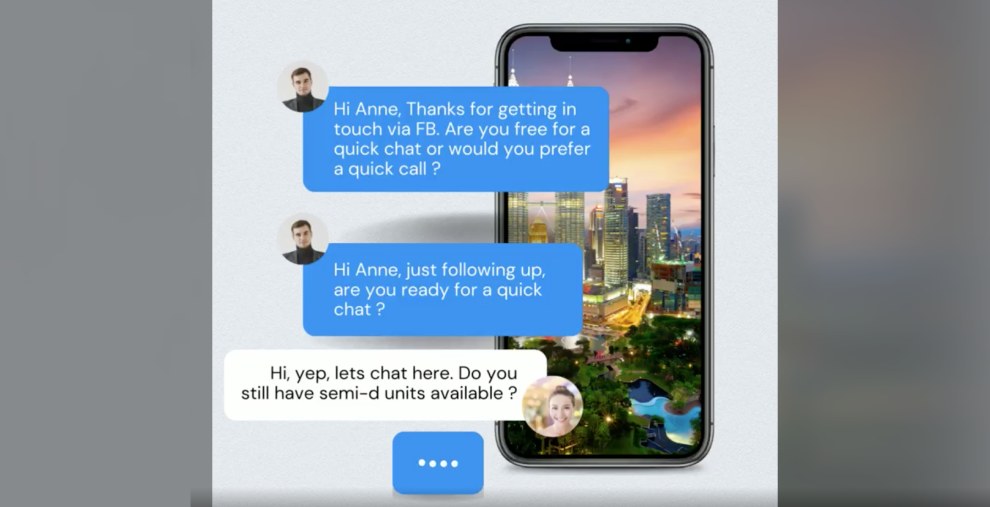
"Hi Sarah, thanks for reaching out. Units currently available are 3-bedroom from RM720k and 2-bedroom from RM540k. Aida from our team covers this project and will call you within the hour. So she can be useful when she does; are you looking to move in yourself, or as an investment?"
The second takes no more human effort than the first. It can be fully automated. But it delivers actual information, names a real person, commits to a specific time, and asks one question that qualifies the lead. The customer now knows something, and something is now happening.
That is a response.
Three auto-replies that fail, and what to send instead
❌ "Our operating hours are Mon–Fri 9am–6pm. We will respond during business hours."
The customer is messaging at 9pm on Saturday because that is when they have time to think about buying. Telling them your convenience does not match theirs is not information it is a rejection with a timestamp.
❌ "Please fill in this form so we can assist you better."
They already contacted you. Asking them to start again on a different surface, to help you, is a cost transfer dressed as service. Most people do not complete the form.
❌ A chatbot menu with no visible way out.
This is the failure Gartner's data speaks to most directly. 87% of customers want a route to a human. A bot that loops without offering one converts a mild query into an active grievance.
The handoff is where the value actually is
Most discussion of AI in sales conversations focuses on whether the AI can answer the question. That is the less important half.
The valuable half is what the AI hands over. When a customer has spent four messages telling a bot their budget, preferred location and timeline, and then a human agent opens with "Hi, how can I help you today?" the whole interaction has produced negative value. You have made the customer repeat themselves and demonstrated that your systems don't talk to each other.
Done properly, the sequence is:
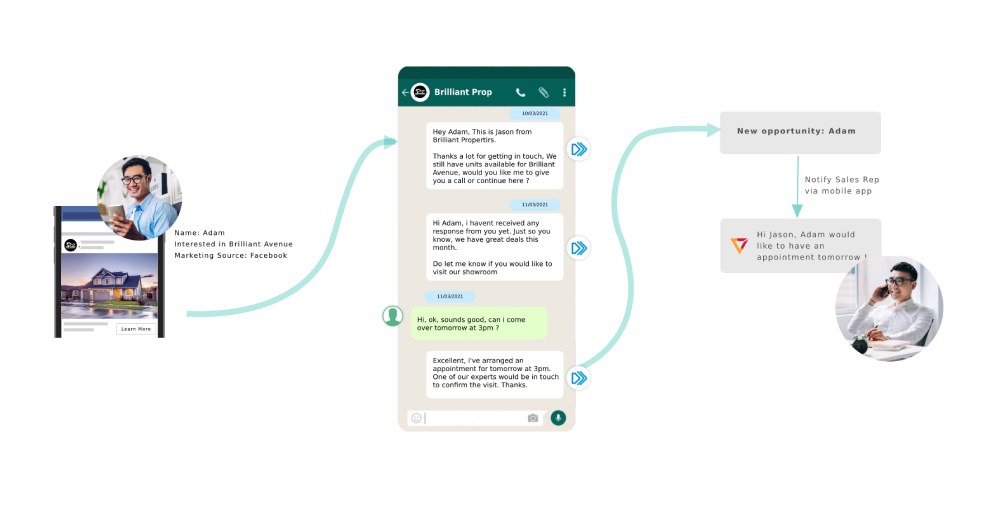
- AI responds substantively within seconds, with real information.
- AI collects two or three qualifying details in natural conversation.
- AI hands to a named human with the full transcript and a summary already attached.
- The human opens with context, not a blank slate.
The customer experiences one continuous conversation that started instantly and got better. That is what "AI plus human" is actually supposed to mean, and it is a considerably higher bar than switching on an auto-responder.
The honest position
There is a temptation, in a market currently saturated with AI messaging, to claim automation solves the response problem outright. It does not. Gartner's own data shows only half of customers find AI makes things easier, and that nearly nine in ten want a human within reach.
What automation reliably solves is the first problem: the enquiry that sits unseen for eleven hours because it arrived on a Saturday. Getting from eleven hours to eleven seconds is real, and it matters.
But an instant reply that says nothing has simply moved the failure earlier in the conversation and made it look more professional. If your automated first message would not be worth a human's time to send, it is not worth the customer's time to read.
This is the mechanic worth getting right before anything else; reply speed and substance. Next, we'll look at what happens after the first message: the follow-up cadence that decides whether a "warm" lead actually closes.
Go and read your own auto-reply. Ask whether, after reading it, the customer knows anything or anything is happening. If not, that message is costing you leads at speed.
Source
Gartner, "Gartner Survey Finds 87% of Customers Say Companies Using GenAI for Customer Service Must Provide Access to a Human Agent," 4 August 2026. Survey of 3,566 B2B and B2C customers conducted February–March 2026. Read the Gartner survey findings.